Locations, routes, sizes, accessibility and operation.
Solar carports
Generate energy without compromising car park operations.
A solar carport must protect vehicles, maintain safe traffic flows, integrate electrical equipment and comply with the requirements applicable to car parks.
Regulatory information verified on June 24, 2026.
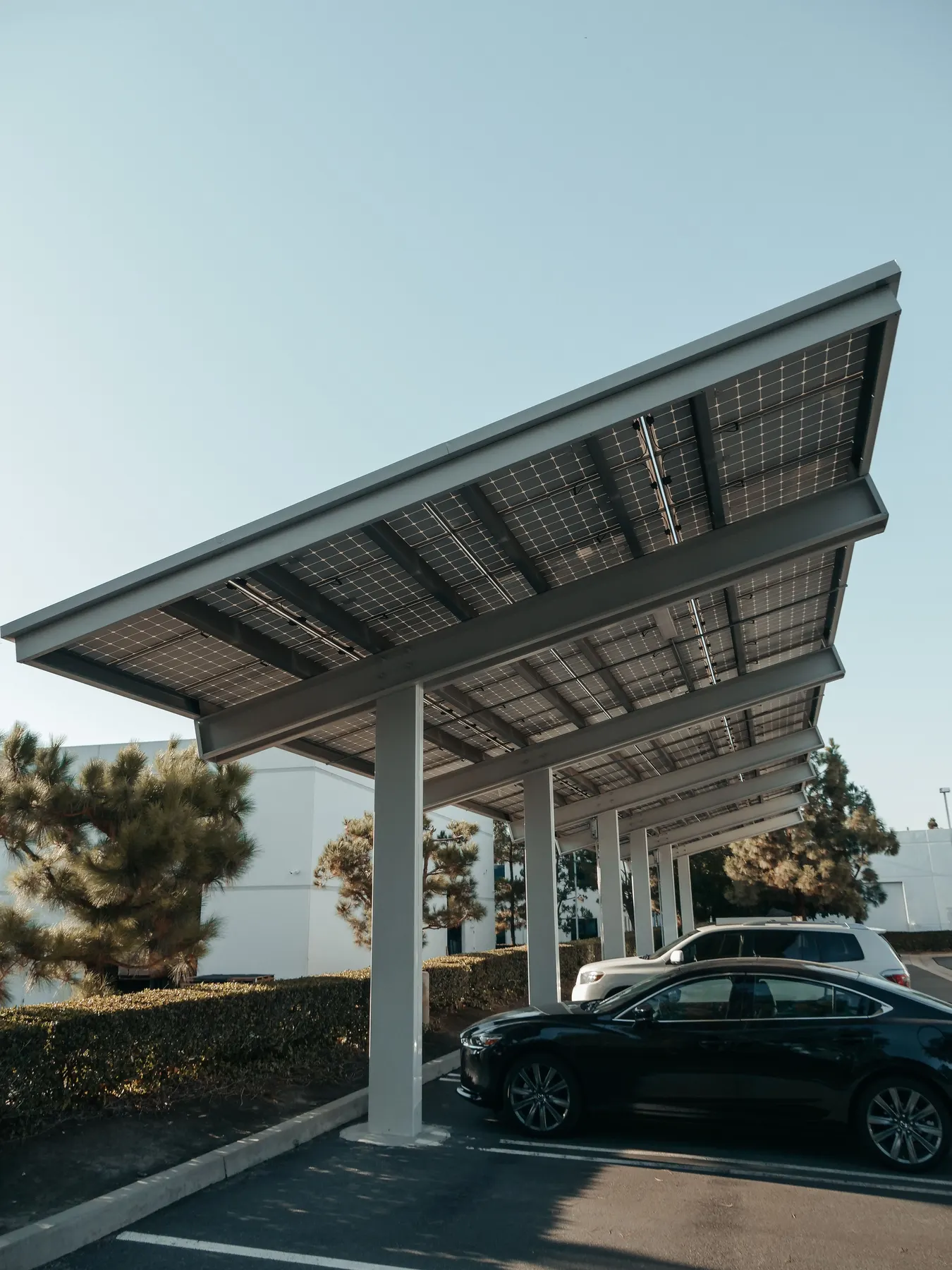
AYM ENERGIE study
What we check before recommending a solution.
Installable capacity is never the only criterion. The site, its use, the grid, local constraints and project economics must remain consistent.
Traffic plan
Entrances, exits, turning radii, deliveries, rescue, PRM and maintenance of operations.
Structural framework
Implementation of posts, spans, foundations, existing networks and geotechnical constraints.
Water management
Collection, infiltration, runoff, slope and interaction with permeability obligations.
Electrical equipment
Inverters, cables, protection, lighting, charging stations and connection.
Phasing of works
Maintaining parking, site security and organization of neutralized zones.
Economy & compliance
Area covered, power, energy yield, CAPEX, obligations and valuation scenarios.
Regulations & procedures
Rules to know before submitting the project.
The APER law introduces phased requirements for certain existing car parks larger than 1,500 m². New or extensively renovated car parks may also be subject to solar-shading and rainwater-management requirements.
This information is general. The PLU, the protected sectors, the network manager and the characteristics of the site may modify the applicable procedures.
- Existing car parks > 1,500 m²In mainland France, Guadeloupe and Martinique, the obligation in principle concerns the shading of at least half of the surface area of the car park.
- Admitted solutionsThe rule can be satisfied by solar carports, by equivalent renewable production or by a mixed solution combining solar carports and vegetation under the conditions provided for by the text in force.
- Main deadlinesFor car parks without a concession: July 1, 2026 from 10,000 m²; July 1, 2028 between more than 1,500 m² and less than 10,000 m², subject to additional deadlines provided for by law.
- New or renovated car parksOutdoor car parks of more than 500 m² built or heavily renovated are also affected by shading and rainwater management devices on at least part of their surface area.
- ExceptionsTechnical constraints, security, architecture, environment, economically unacceptable costs, tree shading or planned transformation may give rise to justified exceptions.
- Urban planning authorizationThe power, height and location determine whether a prior declaration or building permit is necessary.
Recommended route
Transform an idea into a documented decision.
Measure the park
Define the regulatory surface area, the roads included and the areas that can actually be developed.
Map constraints
Networks, lighting, trees, PRM, emergency access, floors and uses.
Compare frames
Test several structures, orientations, powers and coverage rates.
Check the obligation
Analyze the threshold, deadline, exceptions and evidence to keep.
Prepare the file
Assemble plans, production, connection, phasing and administrative documents.
Sources & original texts
Consult the official sources directly.
The links below open the official pages used to summarize the rules of this typology.
service-public.fr
Solar coverage of existing car parks larger than 1,500 m²
Scope of application, surface area calculation, calendar, pooling and exceptions.
Consult the official source ↗ legifrance.gouv.frArticle 40 of the APER law — current version
Consolidated text of the obligation, accepted solutions, exceptions and timetable.
Consult the official source ↗ service-public.frSolar shading and rainwater management for new or renovated car parks
Rules applicable to new car parks or those subject to major renovation.
Consult the official source ↗ service-public.frPlanning permission for solar carports
Formalities depending on power, height and location.
Consult the official source ↗Regulatory content verified on June 24, 2026. Local rules, thresholds, deadlines and versions in force must be confirmed for each project.
Frequently asked questions
The first answers to frame the project.
The surface may include places, paths and paths located in the perimeter between entrances and exits. Certain areas are excluded according to official rules.
Yes under certain conditions when the car parks are adjacent and an agreement documents the distribution of coverage.
No. The structure, networks, ground, circulation, security and connection must be checked before choosing a solution.
Is your car park subject to these requirements?
Send a plan, the surface area, photos and the car park’s operating arrangements.